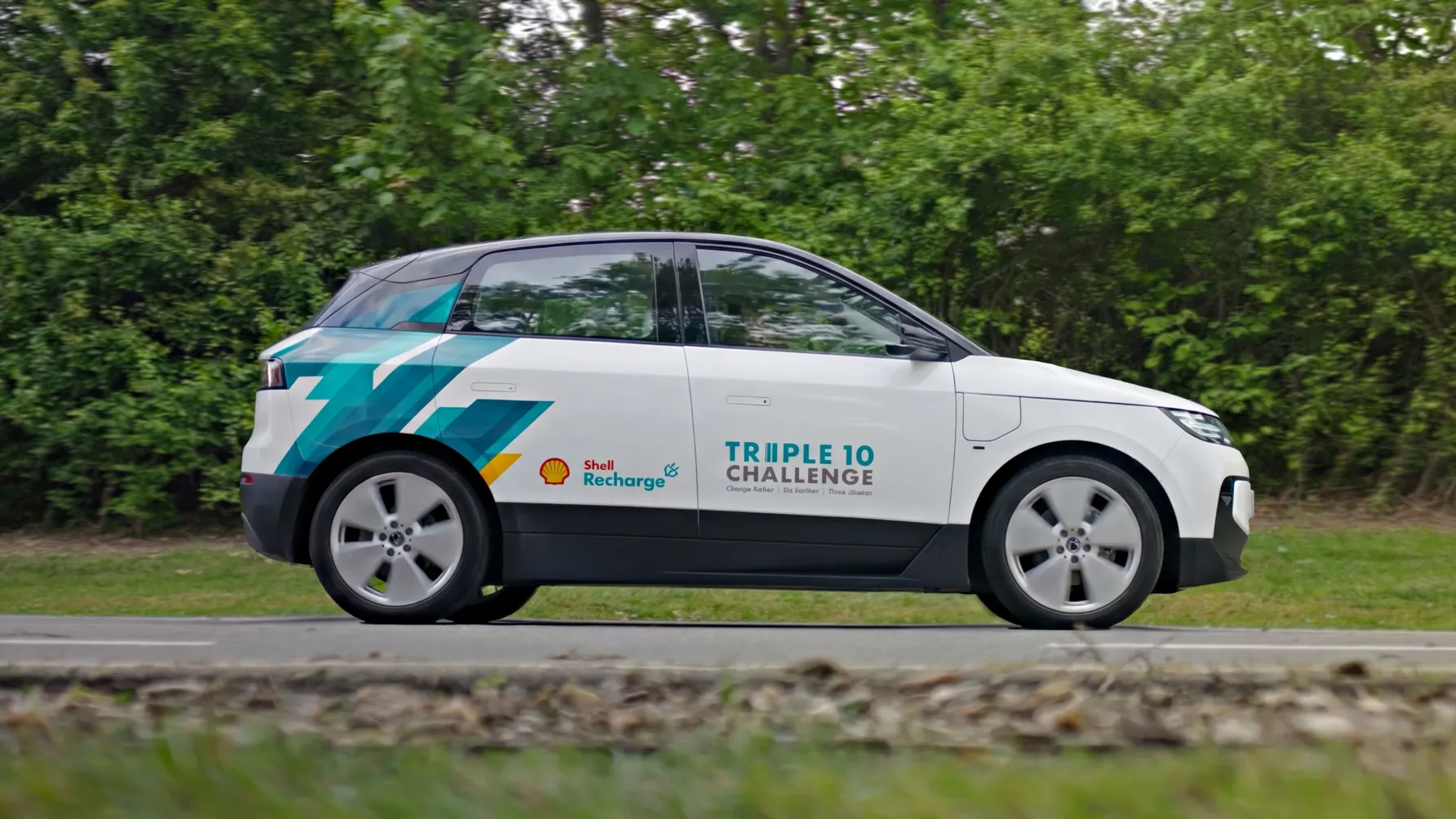
This drivable concept car is a beautiful example of the weight spiral running in reverse. That’s very good news, as the weight spiral, in its normal direction, is knocking holes in the vibrancy, efficiency, and affordability of most modern cars.
You know it: More power needs a heavier cooling system, heavier transmission, heavier brakes, heavier tires, and so heavier suspension…and so more power is needed to overcome the weight of all that paraphernalia. And round the circle you go. The same applies to battery electric vehicles, when you use the obvious solution to adding range: A heavier battery demands at the very least a heavier chassis, and then you might want a stouter powertrain or an extra motor. Oh, and the big battery takes more time to charge, so you lose some of its range advantage, anyway.
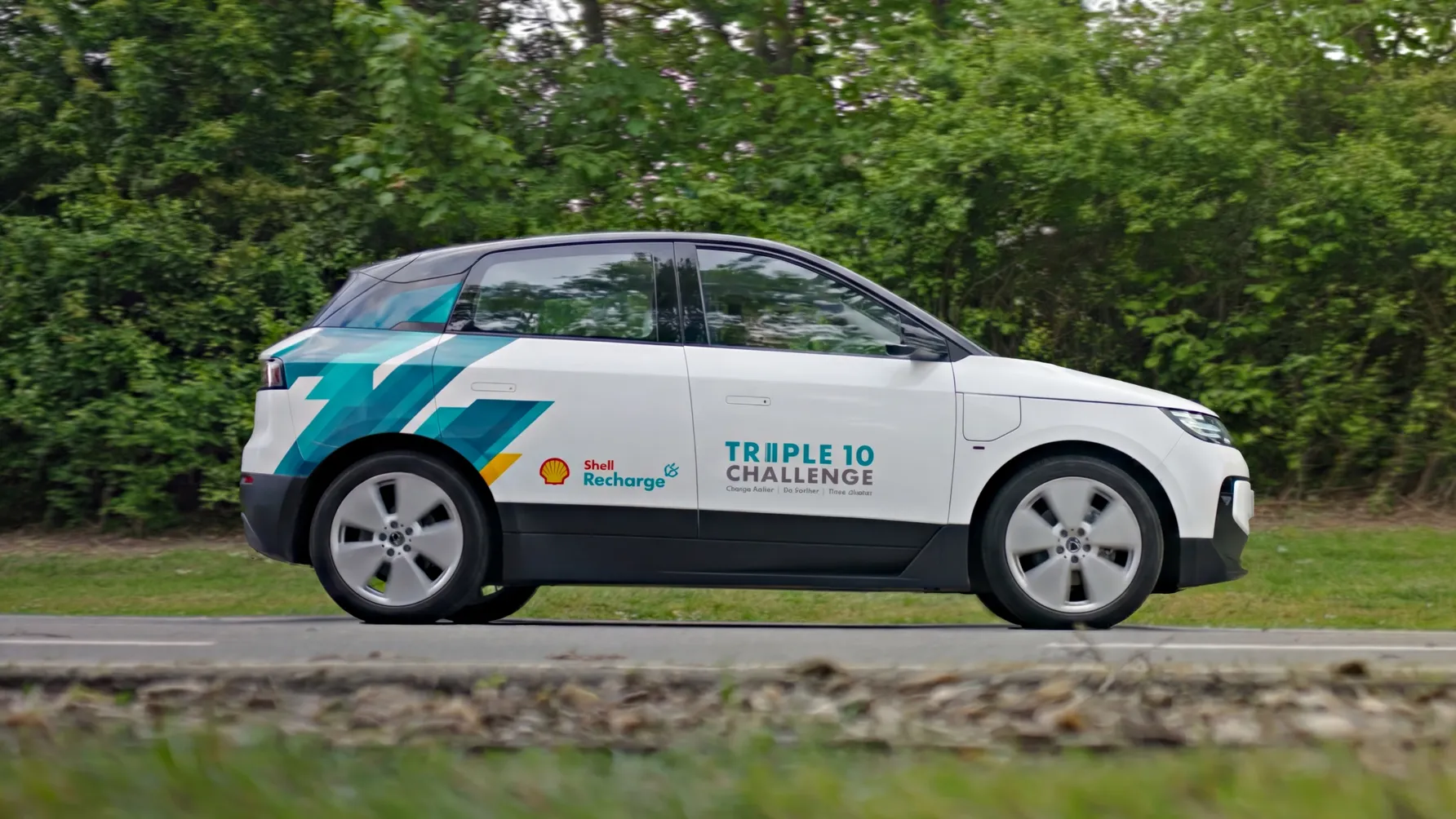
Now, dream of the opposite. Shrink the battery, and everything else falls around it. You get lighter suspension, tires, and brakes, and a smaller motor and transmission. And a lighter body structure. Then it becomes more efficient, and you can reduce the battery some more. With that, resource use tumbles delightfully downwards. Let’s call it the law of returning diminishment.
OTHER STORIES YOU MIGHT HAVE MISSED:
8 Electric vehicles we want to see on PH roads
Honda could bring back the Element with a hybrid engine
With charging stations getting closer together, a smaller-capacity battery is grand in theory. Yet there’s a stumbling block. Today’s small batteries can’t accept high charge power. So, on highway driving, where it’s drag rather than weight that impacts range, you can end up with half an hour charging for every hour driving.
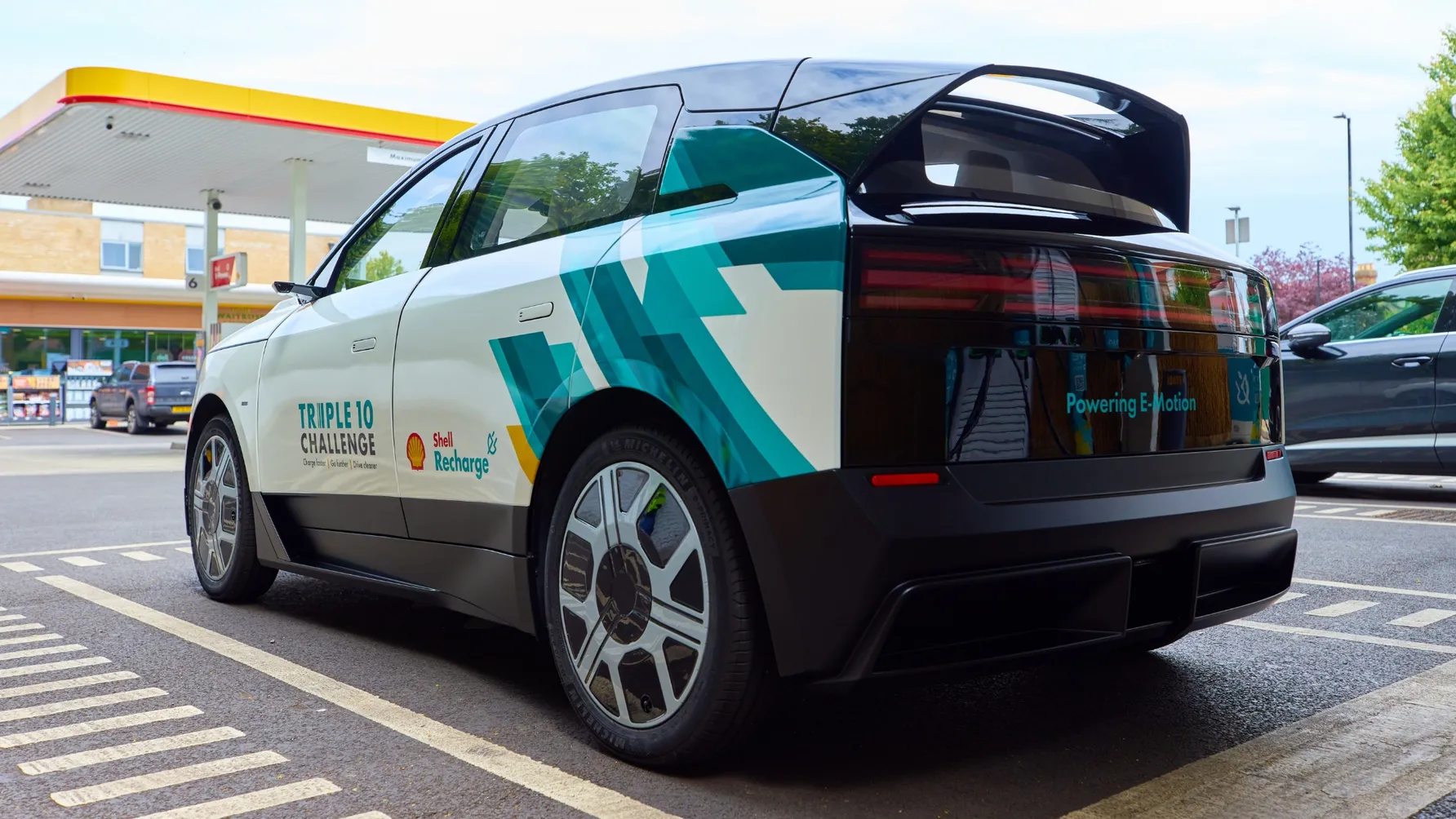
Which is why the car in these pictures might just exhibit the revolution we need. It is built on rapid charging as well as high efficiency, and a crucially low price, too. Even if the critical breakthrough—the battery cooling system—is the same principle as was first used on the McLaren Speedtail and Koenigsegg Regera.
Yes, this car’s great leap forward, battery cooling, isn’t a hugely sexy matter. But fortunately, the results are sexier than that enabler. They’re summed up in the name: Triple 10 Challenge.
That means, first, a 10-minute rapid charging from 10% to 80%. Because efficiency, even at speed, is so good, the rapid-charge time doesn’t actually mean ingesting stupendous amounts of energy. So it can be done on a common 150kWh charger. Efficiency is, in fact, the second of the 10s: 10km/kWh consumption. That’s about a third further per kWh than a comparably sized car now.
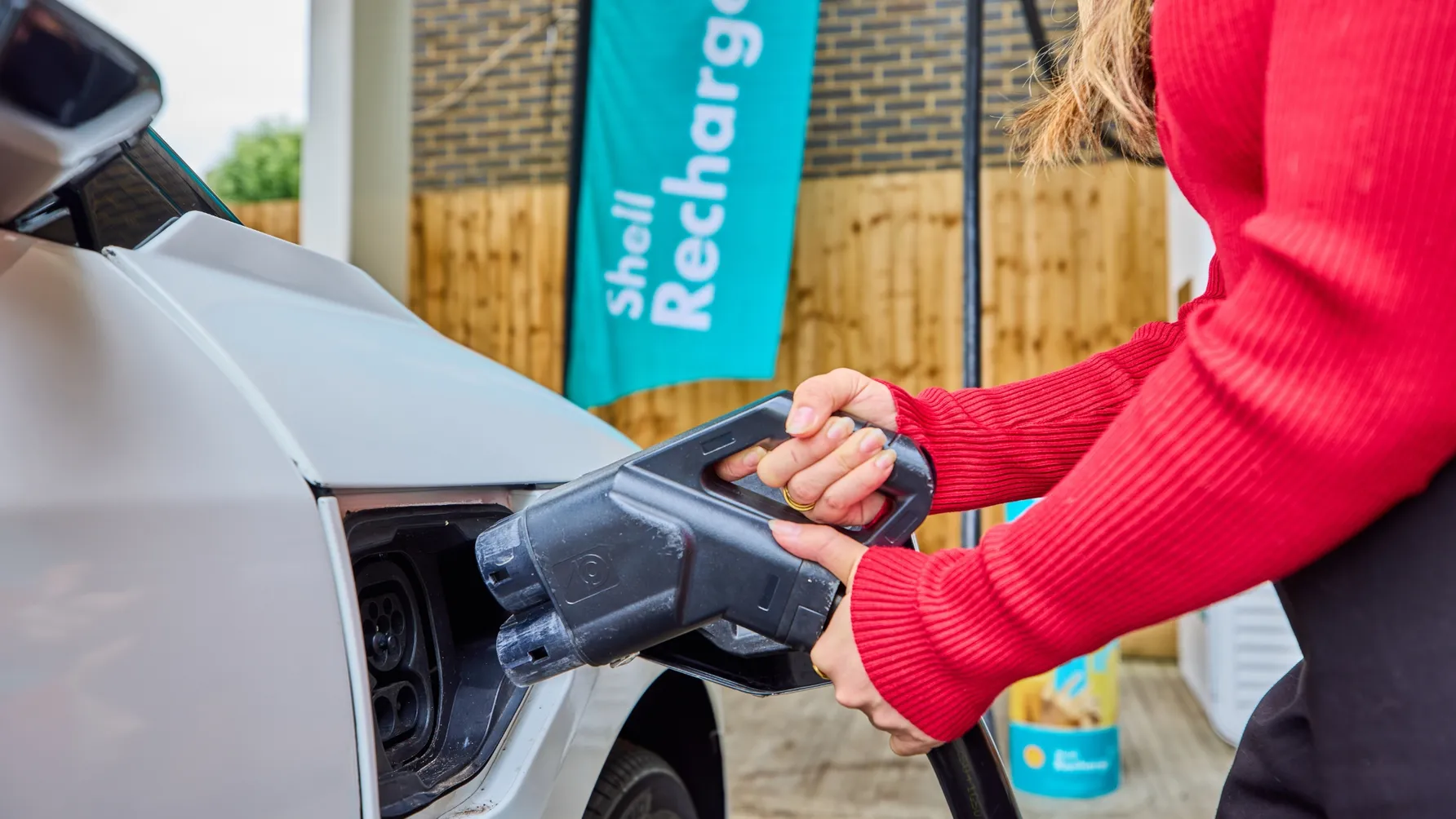
Yeah, we’ve had lots of stories of EVs you can recharge as fast as a fuel stop, but they demand very uncommon ultra-powerful chargers. The Triple 10 Challenge car’s low consumption approaches the problem from the other direction.
Third of the 10s is lifetime CO2 emissions of 10 tons (10,000kg), assuming it’s run on renewable electricity. Most smallish EVs these days are 18-25 tons (18,000-25,000kg) CO2 just for manufacturing, and you’d need three tons from average grid electricity to drive them over a lifetime. Manufacturing CO2 is closely related to price: It takes energy to mine and refine minerals, and energy is costly. Less material means less energy, especially to manufacture a small battery.
Beyond diehard petrolheads, most people who don’t drive EVs say that high price and slow recharging are the barriers to adoption. The Triple 10 Challenge addresses these directly. What’s not to like? Provided it’s a car you’d want to drive.
It stands every chance. Weight is just 1,170kg, the same as a lowish-spec Volkswagen Polo and less than the carbon-fiber-rich BMW i3. That’s propelled by a 136hp electric motor driving the front wheels. No reason why it shouldn’t feel like a lively, although not GTI-spec, supermini on the road.
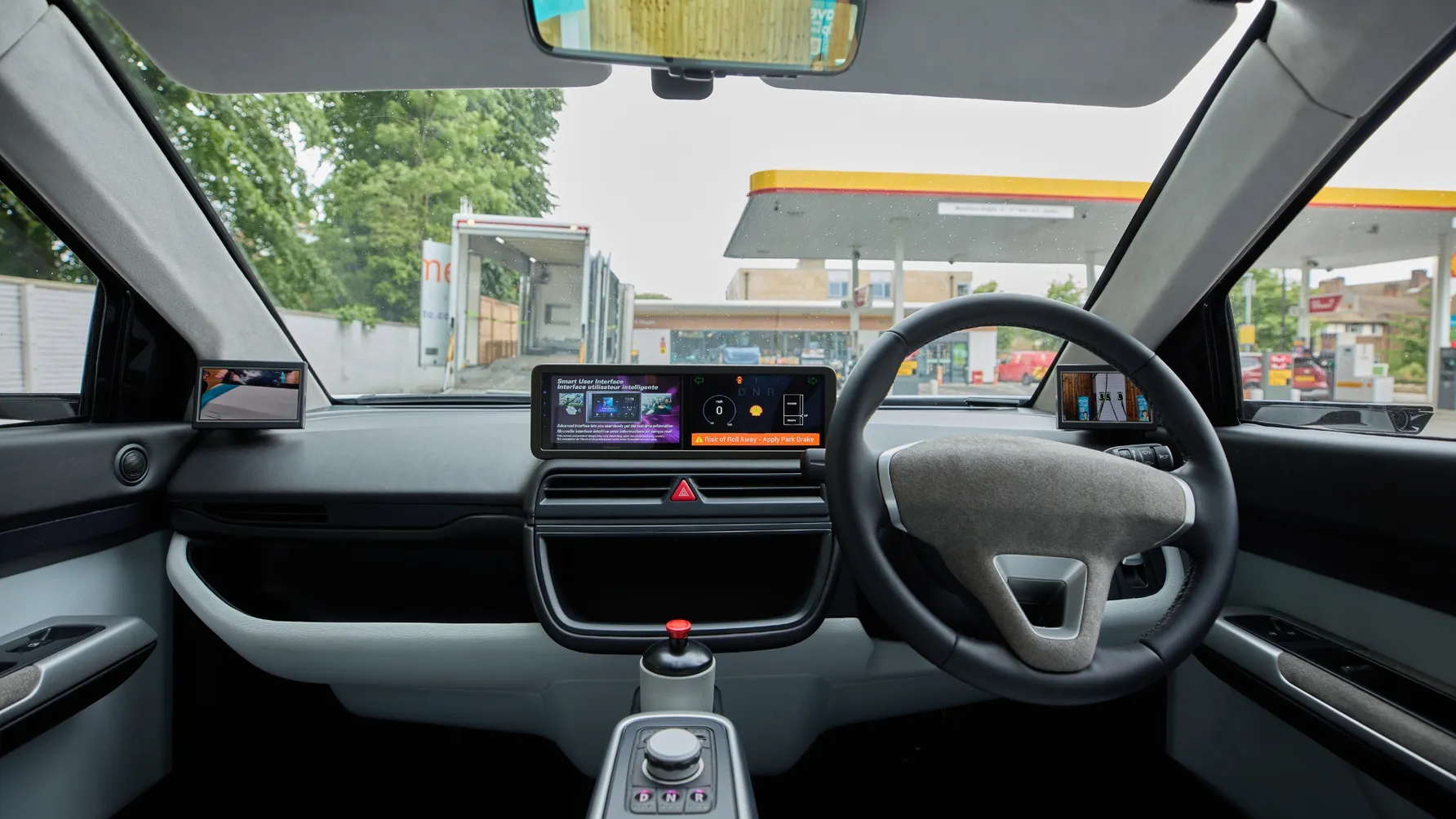
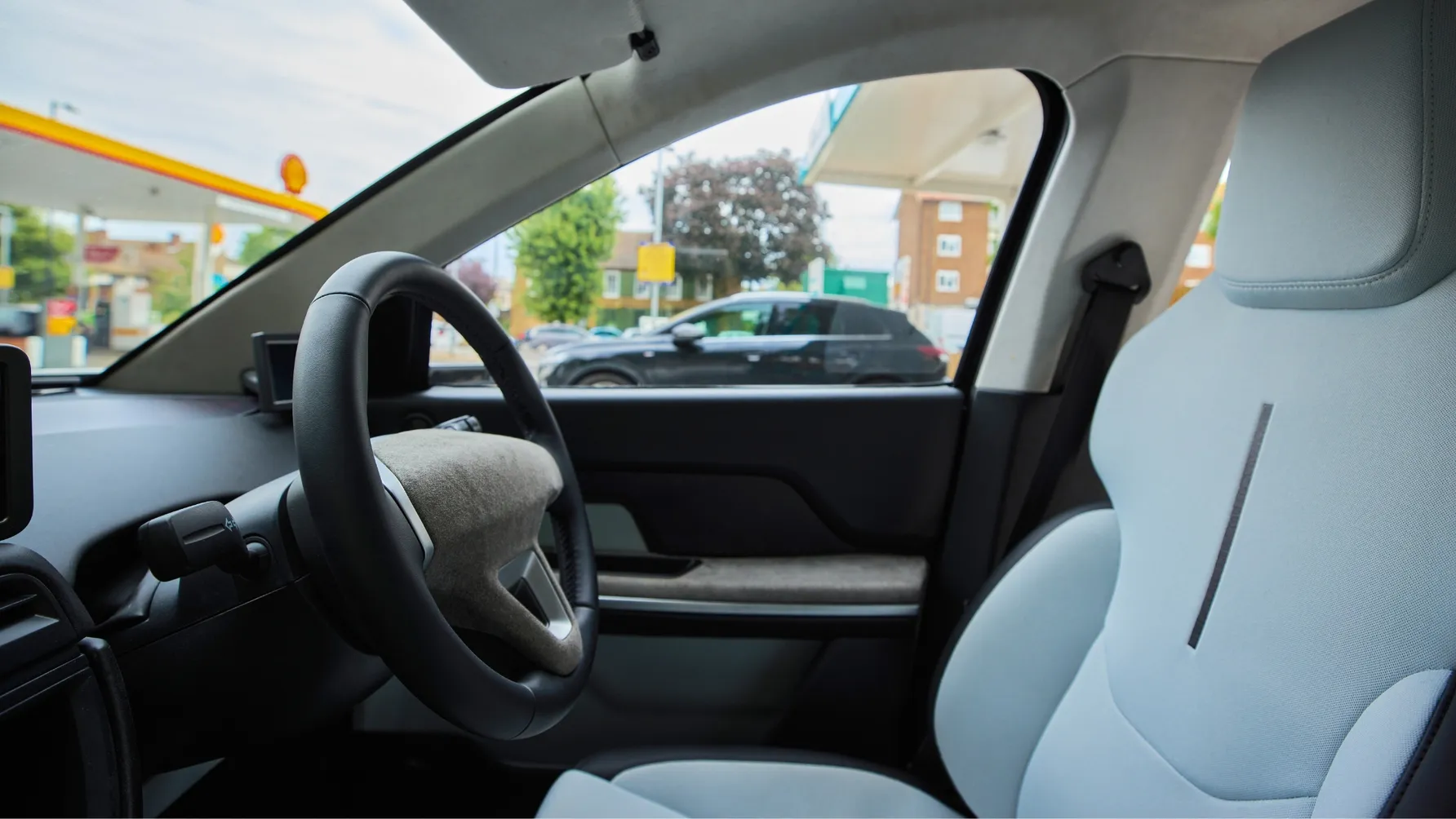
Inside, there’s surprising family room. It’s spacious in the distance between front and back seats. Also, because the battery is small enough to go under the back seat and the trunk, the footwells are comfortably deep. The glasshouse tapers to cut drag—the drag coefficient is just 0.267, and the frontal area is pretty compact, too. So there are just two back seats, lightweight but comfy buckets like the front ones. Their frames are a composite using flax fibers, lightweight and renewable.
It’s a simple, clean, modern cabin design, with two screens. It’s a bit light on switchgear, but otherwise, we’d all be trying to spot where the buttons had been plundered from.
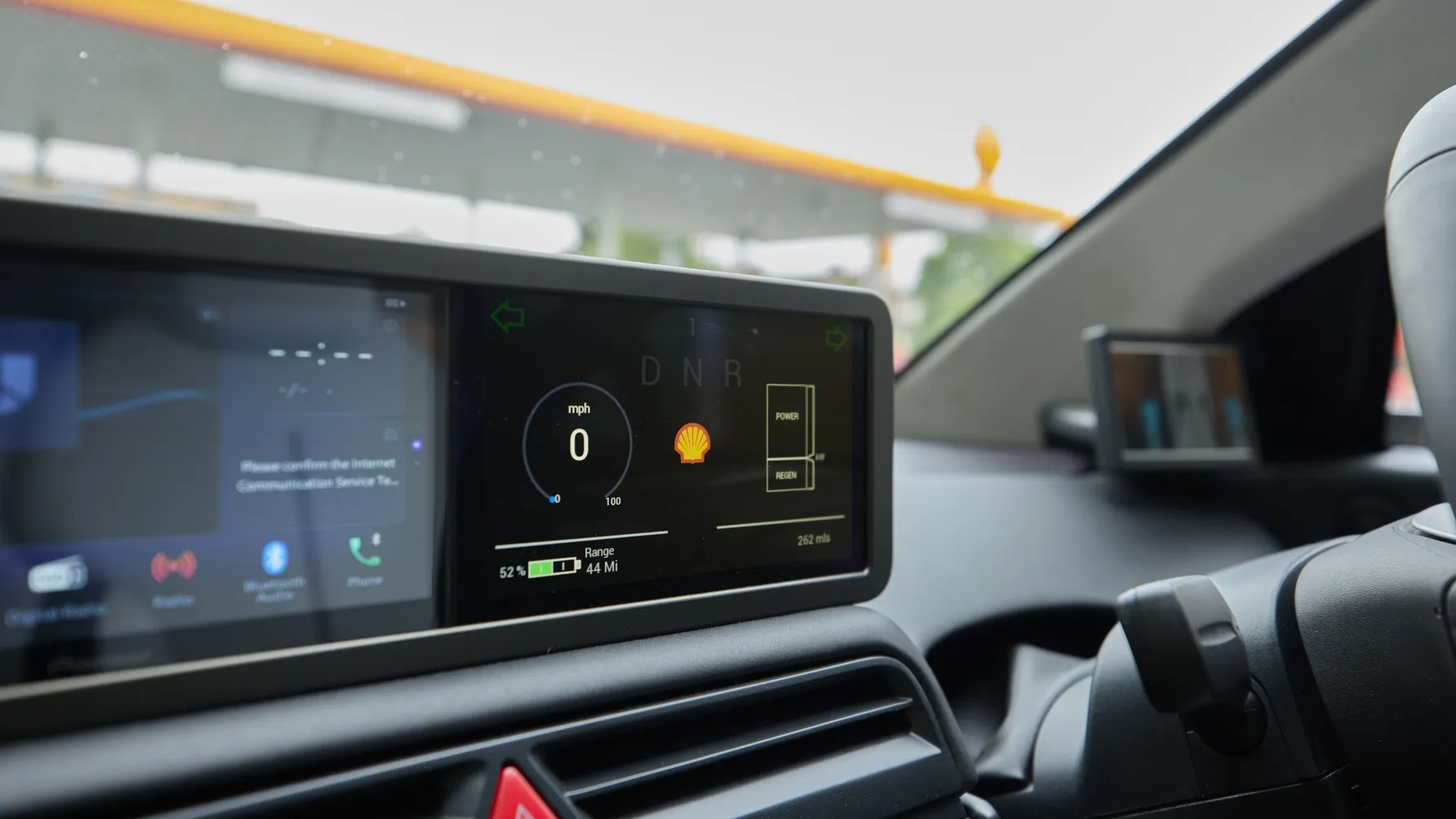
Back to the downward weight spiral. Efficiency means just 210kg of battery. Its capacity is just 31kWh net. Say it quickly so it sounds more. Hang on, though. At 10km/kWh, that’s 312km of range. Even if, like all EVs, it does less than the quoted range when on a highway, you could do close to 500km with just the 10-minute recharge. Is that so bad? Lots of fuel-powered cars can’t do that distance without a stop.
Significantly, your charging options are extensive. Unlike exotic 800V cars with huge packs that demand 350kW chargers, or even some of the incoming ‘megacharging’ or ‘flash charging’ entrants, the Triple 10 Challenge car needs just a 175kW outlet. And you’re not putting in so much electricity, so you’re paying less.
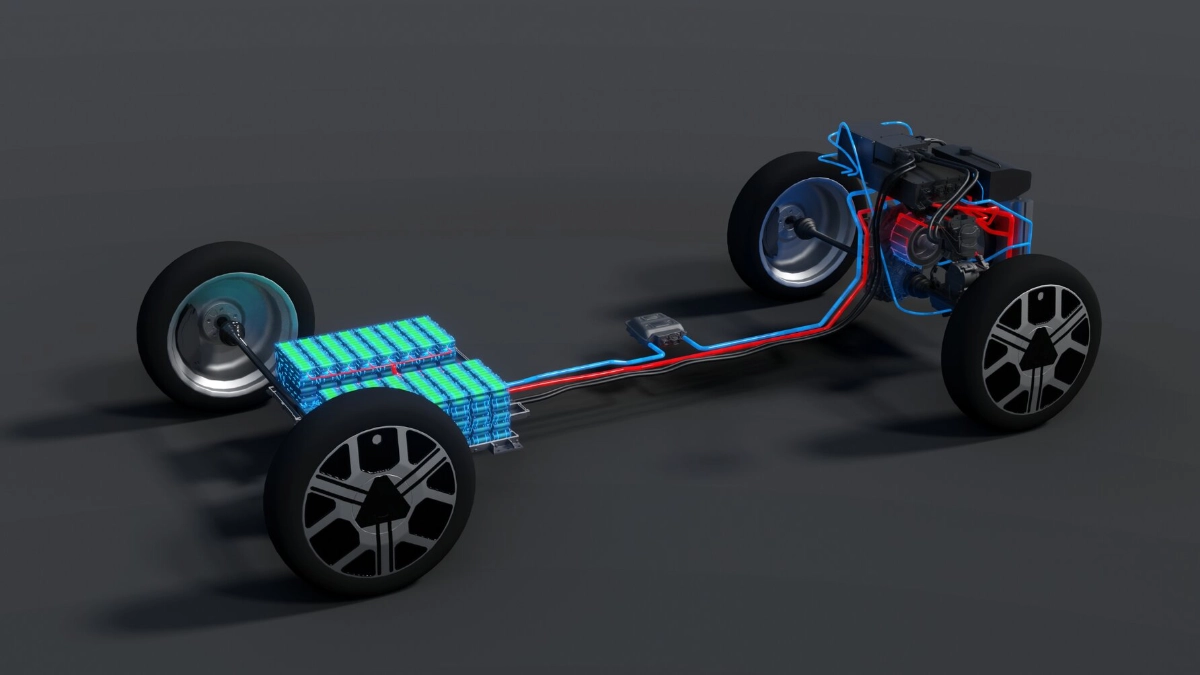
Right, then, back to the enabler of all this—the battery. Again, in pursuit of low cost, there’s nothing particularly exotic about the cells. Physically, they’re the standard cylindrical type, and they’re arranged as usual, like a square of soldiers on the parade ground. In a normal battery, they’d be cooled by plates, themselves water-cooled. The plates are in contact with only about 15% of each cell’s surface. Instead, this battery is immersively cooled—that is, the cells are immersed in a bath of the coolant, giving almost complete contact with the cell surface.
This vastly improved cooling is key to rapid charging. Your normal EV’s battery management system detects the heat buildup in its cells and throttles back charge power after about 50%. This one can keep pumping in, at or close to the full 175kW, to a much higher state of charge.
Obviously, this would be impossible with a water-based coolant because the immersed cells would short out. The liquid used here is dielectric, or insulating. In other words, you could be having a bath in this stuff, and if your intending murderer dropped a live hairdryer in there, you’d be fine. Although disclaimer, we can’t vouch for the dermatological effects of the fluid itself. It’s hardly a tea tree and lemongrass bubble bath.
Shell says you can add 90% more range for every minute on the charger than a conventional EV at the same post. Also, because each cell is cooled more uniformly both within itself and versus its neighbours, the process is less harmful.
The battery was actually developed for the car by race specialists RML, and they’ve already designed an immersively cooled pack, with slightly different cell chemistry, for a hypercar—can’t say which, NDA, blah blah. RML thinks it’ll become more widespread, as PHEVs in particular demand power-dense rather than energy-dense batteries. Power density is the aim with the Triple 10 Challenge (in and out of the battery), as well as low cost per kWh.
The coolant used here, although oil-based, is about the same viscosity as water, and so, having settled on the battery cooling, the engineering team had another brainwave: Instead of having a separate water-based circuit, with separate radiator and pumps, for the motor and high-voltage electronics and charger, and then another for the cabin climate system, those use the same dielectric fluid. They’re in one circuit using off-the-shelf parts. Simpler, lighter, and cheaper. Automatic valves will shut off various parts of the circuit when not needed, so, for example, the battery warms quickly from a cold start.
By the way, when it’s charging, there’s enough thermal inertia in the fluid that usually it’ll just heat that up during the charge event, rather than calling on energy-draining pumps and fans. Then the radiator cools the fluid down again when you drive off, thanks to air now naturally passing through the radiator.
The Triple 10 Challenge car might be a lightweight, but there’s serious design and engineering heft behind it. Initial work on the shape and the frame was by the Gordon Murray Group. Race engineers RML did the battery work, British manufacturer Empel did the motor, and Horiba MIRA did the chassis as well asthe whole car’s validation and testing. It might seem odd that the impetus comes from Shell, an oil company, but it’s the lubricants and coolants division at work here, not the fuel division.
This isn’t like a manufacturer concept that’s an unsubtle hint of a coming road car. It’s a tech demonstrator, and no direct descendant will go on sale. But critically, it doesn’t depend on moonshot manufacturing or materials. It’s an elegant combination of available technologies for a new result. It doesn’t look or feel futuristic.
Instead, it addresses what a lot of car buyers need right now. A cheap, usable car that replenishes fast when you can’t charge at home. An EV that you refuel like a fuel-powered car.

NOTE: This story first appeared on TopGear.com. Minor edits have been made.